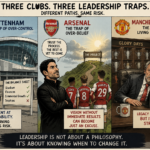

For years, Arsenal lived in a strange emotional economy.
Not poor enough to rebuild, and not dominant enough to win.
They became football’s version of the high-potential company that keeps presenting beautiful strategy decks at Davos while quarterly performance quietly disappoints shareholders.
And yet, something changed last night.
When Manchester City stumbled, and Arsenal were finally crowned Premier League champions after 22 years, the victory felt like more than a football triumph. It felt like the release of accumulated tension. A day of reckoning. Because Arsenal did not merely defeat opponents this season. They defeated narrative fatigue.
Arteta inherited a club drowning in nostalgia and emotional debt. Arsenal fans were still living romantically in Wenger’s Invincibles era while modern football had become colder, more financial, more ruthless. The club had identity, culture, aesthetics, and history, but not enough evidence. Executive leadership is not tested when momentum is obvious. It is tested in the years when belief starts to look irrational. And this is the real lesson for CEOs and senior leaders, especially those who love Arsenal.
Some CEOs confuse legacy with relevance. Executives mistake vision for execution, and their teams start worshipping potential because performance has not yet arrived.
What Arteta achieved was not cosmetic. He rebuilt institutional psychology, which is harder than tactics.
He taught Arsenal how to handle pressure without panicking. He showed them how to withstand ridicule without abandoning their philosophy, and how to maintain emotional discipline while the entire league questioned whether they had the nerve to finish. That matters because pressure exposes culture faster than success ever will.
Last night was not machine-like dominance like Amazon in the online retail space. Arsenal’s triumph felt different. It was more human, more fragile, more earned. A club repeatedly bruised by almosts finally discovers emotional maturity. (The Guardian)
And perhaps that is why so many executives see themselves in Arsenal.
Not everyone is born Manchester City with infinitely resourced, relentlessly optimised, emotionally detached. Some organisations must fight through public doubt as they rebuild, whilst others must continue to speak conviction long before results make it fashionable.
Arsenal’s title was ultimately a case study in delayed validation. The modern corporate world has very little patience for that. Boards want transformation in two quarters. Investors want certainty before evidence exists. Social media punishes long-term thinking because panic performs better online.
But Arsenal proved something deeply unfashionable: sometimes the most strategic thing a leader can do is endure long enough for the system to mature.
After 22 years, the trophy is finally back in North London.
But the real achievement is subtler than silverware.
Arsenal stopped behaving like a club haunted by history.
And started behaving like one worthy of the future. (The Guardian)
Congratulations, Arsenal, and all its supporters and true fans!!
Dr Judith Ogedegbe | Leadership Impact Advisory